Small Freezer-Meal Plan for Busy Parents: Two Dinners for Later
Build a small freezer-meal plan with two familiar recipes, clear portion counts, a grocery worksheet, freezer labels and safe thawing tips.
 Sophie Bennett♥0 Likes!
Start with two familiar recipes and aim to bank two future dinners. Cook an extra batch when you already have time to make dinner, portion it for the people who will eat it, and put the serving instructions on the container. You do not need a month of meals or an entire Sunday in the kitchen.
This freezer-meal plan is for busy parents who want a small, manageable backup. It includes serving arithmetic, a grocery-list worksheet, a copyable freezer label and a thawing reminder. It is a planning guide, not a set of new kitchen-tested recipes; use recipes you already trust, including their cooking and freezing instructions.
Choose two meals your household already eats
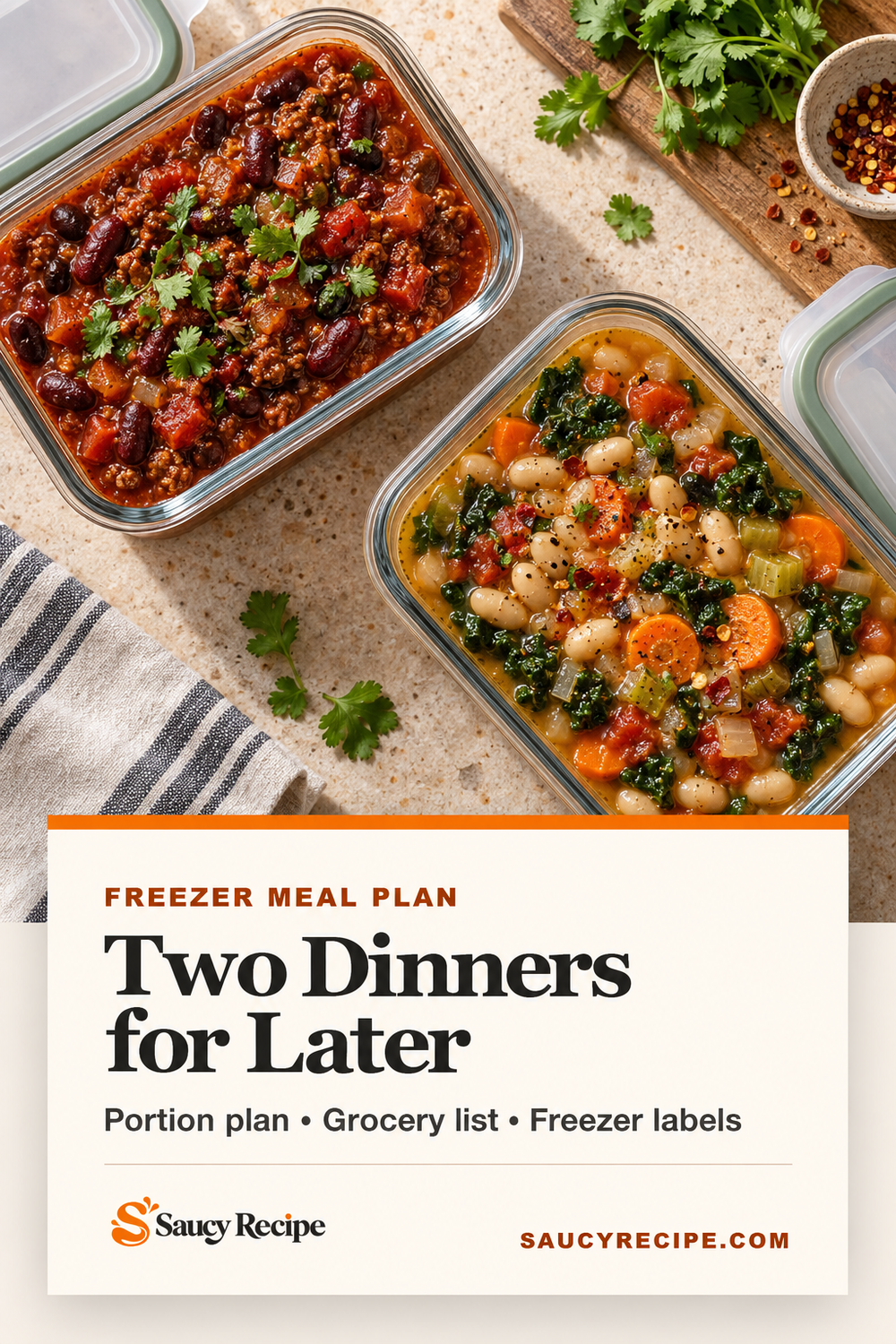
Write down two reliable dinner recipes before you buy anything. For a first attempt, consider a bean chili and a vegetable or lentil soup with freezing instructions. These are meal ideas, not claims that a particular Saucy Recipe formulation has passed a freeze-and-reheat test.
Choose one recipe at a time if your fridge, freezer or cooking pot is small. A familiar dish with a clear reheating method is more useful than six unfamiliar dishes that nobody wants to eat. Save the recipe link or page number with the meal so another adult can finish dinner without finding the original cook.
- Check what is already available: count usable pantry ingredients and existing frozen meals before shopping. University of Minnesota Extension recommends starting meal planning with the food you have and the family calendar.
- Plan the whole plate: write the bread, fresh vegetables, toppings or other sides alongside the main dish. Keep anything that needs buying or preparing on serving day visible.
- Respect the recipe: use its stated yield, equipment and freezing method. If the recipe has no freezing guidance, trial one portion before making a large reserve.
- For meals given to a new parent: ask about preferences, allergies, available appliances and freezer space. Include the ingredient list and any packaged-ingredient allergen information.
Source: University of Minnesota Extension: meal planning.
A small freezer-meal plan: two dinners now, two later
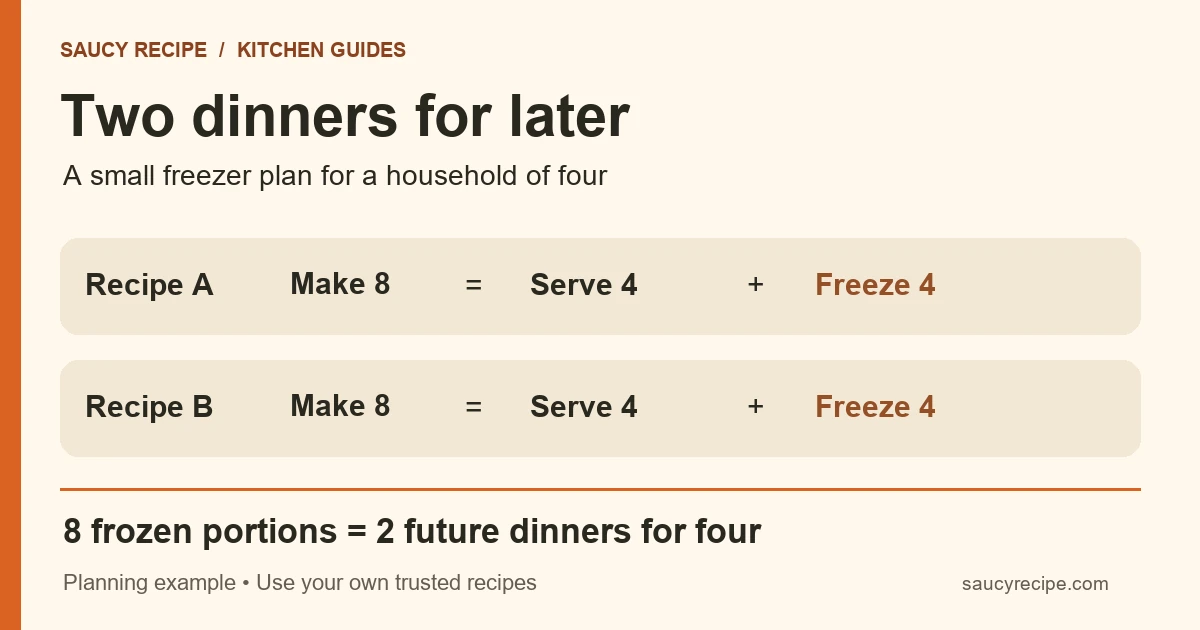
The worked example below assumes four dinner portions per household meal. For each of two cooking sessions, make eight portions: serve four and reserve four for the freezer. After both sessions, you have served eight portions and banked eight more—two future dinners for four people.
| Cooking session | Make | Serve now | Freeze | Future dinner |
|---|---|---|---|---|
| Recipe A: your familiar chili | 8 portions | 4 portions | 4 portions | One dinner for four |
| Recipe B: your familiar soup | 8 portions | 4 portions | 4 portions | One dinner for four |
| Total across both sessions | 16 portions | 8 portions | 8 portions | Two dinners for four |
For two people: make four portions of each recipe, serve two and freeze two. That gives four portions to eat now and four frozen portions: two future dinners for two. A “portion” means the serving size that works for your household; it is not an age-based nutrition prescription.
Use this scaling calculation: recipe multiplier = desired portions ÷ original recipe yield. An original four-portion recipe needs a multiplier of two to make eight portions. Check pot capacity and follow any scaling notes; doubling quantities does not mean doubling the cooking time. If capacity is tight, make two ordinary batches instead.
Count containers before cooking
For the four-person example, choose four containers that each hold two of your recipe’s portions, or eight single-portion containers. Two containers of Recipe A make one family dinner; two of Recipe B make the other. Use appropriately sized, shallow food containers and follow the manufacturer’s freezer, fill-line and reheating instructions. Portion count does not tell you the required container volume: check the actual food volume before shopping for containers.
Build one grocery list from both recipes
- Copy every ingredient and its unit from Recipe A and Recipe B, after adjusting the yields.
- Combine matching ingredients measured in the same units. Keep drained beans separate from the unopened can weight, and do not add cups to grams without a reliable conversion.
- Subtract the usable amount already in your kitchen.
- Choose package sizes that cover the remaining amount. Give any surplus a planned use.
- Add sides, toppings and packaging supplies to the list.
Illustrative shopping arithmetic only: suppose your selected recipes require 300 g and 200 g of onion. That is 500 g total. If you have 150 g usable onion, you need 350 g more. Buying 500 g leaves 150 g for another planned meal. These numbers demonstrate the calculation; they are not the ingredient list for the chili or soup above.
| Ingredient and unit | A + B needed | Usable amount at home | Still needed | Buy / remainder plan |
|---|---|---|---|---|
| Onion, g (example) | 300 + 200 = 500 | 150 | 350 | Buy 500 g; use remaining 150 g in another meal |
| Your ingredient: ______ | ______ | ______ | ______ | ______ |
| Your ingredient: ______ | ______ | ______ | ______ | ______ |
| Sides / toppings: ______ | ______ | ______ | ______ | ______ |
For a complete fresh-cooking example of ingredient overlap, see Three Dinners with One Grocery List for Two. That is a separate dinner plan, not a tested freezer version of this guide. Our grocery-list generator can help consolidate supported recipe ingredients; review mixed units and add any external recipe or serving-day extras yourself.
Fit the preparation around two ordinary dinners
Before the first session: allow about 15–20 minutes to choose recipes, count portions, check storage space and write the list. This is a planning estimate, not a measured cooking-session time. Cooking, cooling, freezing and reheating times depend on your chosen recipes and equipment.
- Prepare the storage area first. Have shallow containers, labels, a marker and a food thermometer ready. Check the fridge and freezer temperatures.
- Cook Recipe A fully according to its method. Do not partly cook a meat dish and treat it as a ready-to-reheat meal.
- Serve the planned amount and promptly cool the reserve safely. Follow the food-safety instructions below. Pack and label the reserve for freezing once chilled.
- Repeat with Recipe B on another suitable day. Keep the sessions separate if doing both would leave too much food waiting to cool.
- Book the future meals. Put a refrigerator-thawing reminder before each planned serving day. Cross the containers off the inventory when you use them.
A freezer label someone else can use
Copy the following fields onto each container. Record actual dates and the chosen recipe’s instructions; avoid an unexplained label such as “dinner.”
- Dish / recipe link: ____________________
- Cooked on / frozen on: ____________________
- Status: fully cooked; requires reheating
- Portions in this container: ______
- Ingredients and allergens: ____________________
- Thawing and reheating instructions: ____________________
- Serving-day sides or additions: ____________________
- Planned use date: ______ (an inventory target, not a universal expiry date)
Keep a matching note on the freezer door: Dish | containers remaining | portions per container | frozen date | planned serving date. In the worked family example, start with “A: 2 containers × 2 portions” and “B: 2 containers × 2 portions.” Cross off two containers after each family dinner. For adults eating at different times, single portions may be easier.
Cool, freeze, thaw and reheat safely
The main checklist here uses U.S. USDA guidance. Divide cooked reserves into shallow containers and refrigerate promptly, within two hours—or one hour above 90°F/32°C. Do not leave a large pot on the counter overnight. USDA permits small portions of hot food directly in the refrigerator or rapid chilling in an ice-water bath. Once chilled, package the intended reserve for freezing.
Thaw in the refrigerator. If using a microwave to thaw cooked leftovers, continue reheating immediately. Reheat leftovers to 165°F/74°C, measured in several places with a food thermometer; bring soups, sauces and gravies to a rolling boil. Use only containers suitable for the chosen heating method. These steps cannot rescue food that was previously handled unsafely. Source: USDA: Leftovers and Food Safety.
Storage reference: FoodSafety.gov lists 3–4 days refrigerated at 40°F/4°C or below for soups and stews, and 2–3 months frozen for quality. Food kept continuously at 0°F/−18°C or below remains safe indefinitely, but quality declines. Freeze your planned reserve promptly; do not use the fridge as a week-long holding area. Follow shorter product or recipe-specific directions where applicable. Source: FoodSafety.gov cold-storage chart.
UK readers: the Food Standards Agency advises cooling and refrigerating cooked food within 1–2 hours, eating refrigerated leftovers within 48 hours or freezing them, and using fully defrosted food within 24 hours. Its fridge range is 0–5°C and freezer temperature around −18°C. Follow your local guidance rather than mixing storage windows. See FSA chilling, freezing and defrosting guidance.
When the plan does not fit the week
- The freezer is already full: use a meal from the inventory first, or reserve just one future dinner. Do not cook extra food without safe cooling and storage space.
- There is no time for a batch session: add one extra normal batch to a dinner you were already making. The second recipe can wait.
- One container is too much: portion smaller before freezing next time, so the amount thawed matches the people eating.
- The recipe tastes different after freezing: note the result after trying one portion. Change the recipe choice or serving-day finish before making several more batches; freezing suitability varies.
- A serving-day ingredient is missing: put it in the label’s “additions” field and on that week’s grocery list. A frozen main dish is only as convenient as its remaining steps.
Common freezer-meal questions
How many freezer meals should I start with?
Two future household dinners are a manageable starting target. For four portions per dinner, that means eight frozen portions, not eight family meals. Adjust the goal to the space you have and what your household will actually eat.
Do I have to freeze the entire dinner?
No. You can reserve a main dish and plan a simple side on serving day. Write that extra task on the label so “freezer dinner” does not unexpectedly require a shopping trip.
What makes a freezer meal useful for a new parent?
Familiar flavors, an agreed portion size, a complete ingredient label and instructions that another adult can follow. Ask what the recipient wants before cooking. This guide covers meal logistics; it does not prescribe a pregnancy or postpartum diet.
Are the chili and soup in this plan tested recipes?
They are examples of recipe types to choose, not new Saucy Recipe formulations. Use a trusted recipe with freezing instructions and try a portion before scaling up. No kitchen test, freezing trial, measured saving or nutritional analysis is claimed for this planning example.
Next step: choose Recipe A, count the portions needed for dinner plus one reserve, and fill in its grocery-list rows. Add Recipe B after that first session fits comfortably into your week.
Food-safety sources checked October 2, 2026. Source review is separate from recipe cook testing.